

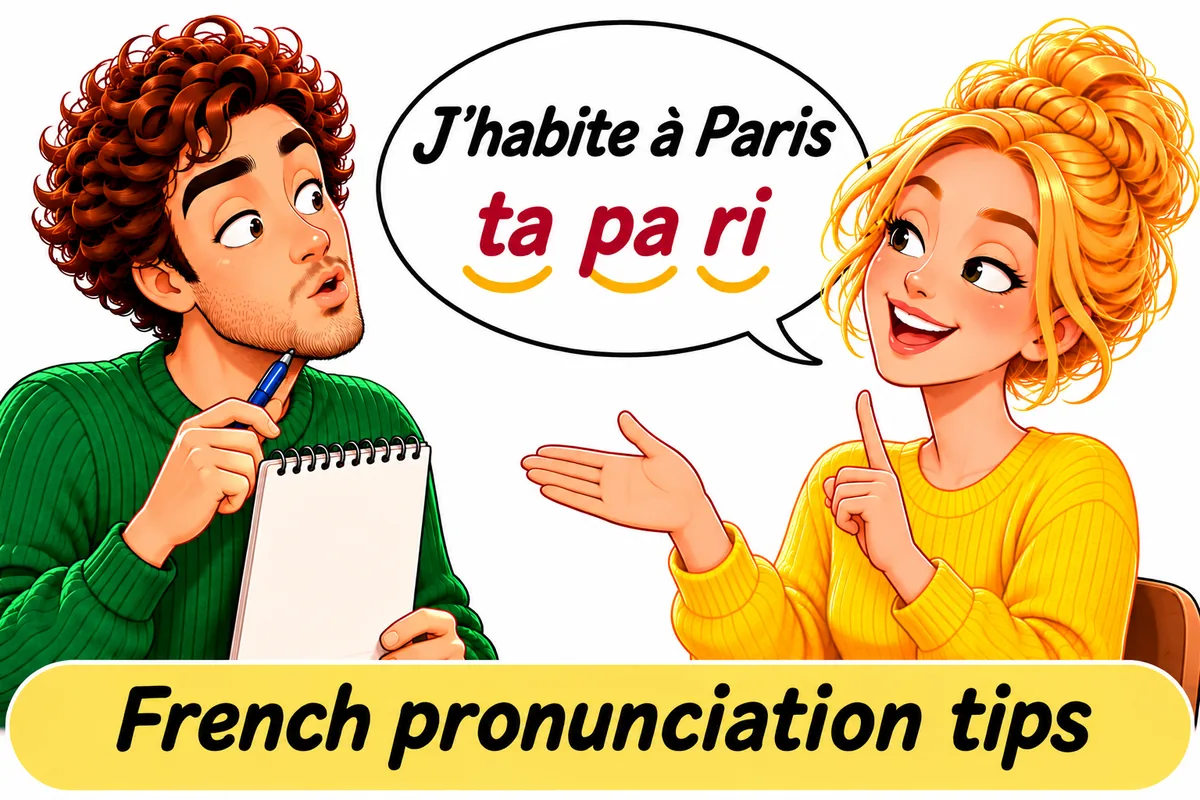
You have learned the grammar, you know plenty of vocabulary… and yet, when you speak, French people sometimes look at you with a polite, slightly confused smile, or simply answer in English. Sound familiar?
The good news is that French pronunciation follows clear patterns. French pronunciation is not just about producing individual sounds. It’s about learning how those sounds flow together. Once you understand a few key differences with English, everything becomes easier. Here are my ten most useful French pronunciation tips, with simple exercises to practise on your own.
Why French pronunciation feels so different from English
English is a stress-timed language: some syllables are strong, others are almost swallowed. Think of the word comfortable, where the first syllable carries all the weight. French is often described as a syllable-timed language: its syllables tend to have a more even rhythm than in English.
This difference is one of the main reasons why French sounds smoother and more even than English, and why English speakers often bring a distinctive rhythm to their French. Many of the tips below come back to it. I often tell my students that English is like salsa dancing, with strong beats and quick, lighter steps in between, while French is more like walking at a steady pace.
10 French pronunciation tips for English speakers
1. The rhythm of French syllables
Start by giving each syllable of the word important roughly the same length: im-por-tant, da da da, /ɛ̃-pɔʁ-tɑ̃/. Let each vowel ring out a little. Avoid stressing the first syllable as you would in English.
In French, syllables tend to have a more even rhythm than in English. Instead of strongly stressing one syllable and reducing the others, try to give each syllable its full vowel sound.
Now here’s another important detail: the final syllable tends to be slightly longer.
Listen to the following French words. They look very similar to their English equivalents, but their rhythm is quite different. Pay special attention to the final syllable. Can you hear how it stretches out a little longer than the others, especially on the vowel?
| French word | Rhythm | Pronunciation |
|---|---|---|
| Cinéma | da da daa | /si-ne-ma/ |
| Restaurant | da da daa | /ʁɛs-to-ʁɑ̃/ |
| Gouvernement | da da da daa | /gu-vɛʁ-nə-mɑ̃/ |
| Confortable | da da daa | /kɔ̃-fɔʁ-tabl/ |
| Opéra | da da daa | /o-pe-ʁa/ |
2. The secret of French syllables
In French, most syllables end with a vowel, while in English, syllables are much more likely to end with a consonant. This is one of the key differences between the two languages, and it has a huge impact on the way French sounds. The secret? Learn to connect your sounds and let your vowels flow!
When a word ends in a pronounced consonant and the next word begins with a vowel, French speakers naturally connect the sounds, so the consonant becomes the beginning of the next syllable. For example, une bonne idée /yn-bɔ-ni-de/.
Now, listen to the difference. Can you hear how the final consonant of one word connects to the vowel of the next?
| Typical mistake | Natural French | |
|---|---|---|
| Une estimation | /yn-ɛs-ti-ma-sjɔ̃/ | /y-nɛs-ti-ma-sjɔ̃/ |
| Une femme élégante | /yn-fam-e-le-ɡɑ̃t/ | /yn-fa-me-le-ɡɑ̃t/ |
| Un vase ancien | /ɛ̃-vaz-ɑ̃-sjɛ̃/ | /ɛ̃-va-zɑ̃-sjɛ̃/ |
| Je m’appelle Isabel | /ʒə-ma-pɛl-i-za-bɛl/ | /ʒə-ma-pɛ-li-za-bɛl/ |
3. Stress the end of the group
Look at these pairs of sentences. They have different meanings and are written differently, but they can sound exactly the same: /ʒɑ̃.lɛv.mɔ̃.pɑ̃.ta.lɔ̃/!
- Jean lève mon pantalon (Jean lifts my trousers)
- J’enlève mon pantalon (I take off my trousers)
So how can you tell them apart? Listen carefully! Can you hear the difference?
- Jean / lève mon pantalon: Daa / da da da da daa
I slightly lengthen the syllable of Jean, just before the pause.
Here’s a useful trick for English speakers learning French: when the subject is a noun rather than a pronoun, try making a slight pause after it. This can help you identify the rhythmic groups and give your French a more natural rhythm. - J’enlève / mon pantalon: Da daa / da da da daa
I slightly lengthen the last syllable of enlève, just before the pause.
Look at these other pairs of sentences. They have different meanings and are written differently, but they can sound exactly the same: /mɔ̃-fʁɛ-ʁe.ne/!
- Mon frère aîné (my older brother)
- Mon frère est né. (my brother was born)
So how can you tell them apart? Listen carefully! Can you hear the difference?
- Mon frère aîné: Da da da daa
I slightly lengthen the last syllable. - Mon frère / est né: Da daa / da daa
I slightly lengthen frère before the pause, then né at the end of the sentence.
In French, the last syllable of each rhythmic group tends to be longer. By changing the way we group words together, we can change the rhythm of a sentence, even when the sounds themselves are identical.
In English, stressed syllables often help us identify individual words. In French, words tend to blend together within a rhythmic group, making word boundaries much harder to hear.
The key is to stop pronouncing each word separately and start thinking in groups of words.
4. Let your vowels flow!
Here’s a simple but surprisingly effective exercise: remove all the consonants from a sentence and keep only the vowels. The aim is to become aware of the continuous flow of French vowels. Your vocal cords should keep vibrating as you move from one vowel to the next.
Listen and try to repeat, placing a finger on your throat to feel the continuous vibration!
| Sentence | Vowels only |
|---|---|
| 1. Tu vas bien ? | y a ɛ̃ |
| 2. Ça va ? | a a |
| 3. J’habite à Paris | a i a a i |
| 4. Vous êtes français ? | u ɛ ɑ̃ ɛ |
Can you hear it? Take Tu vas bien ?, for example.
It’s almost as if the /y/ gradually melts into the /a/, which then melts into the /ɛ̃/, without your voice ever stopping.
That’s the feeling you are aiming for: a smooth, continuous flow of vowels!
5. Master the difference between “u” and “ou”
This is one of the most important sounds in French, because it changes meaning: tu (you) and tout (all), dessus (on top) and dessous (underneath).
My husband is Australian, and when he says pull (sweater), French people often understand poule (chick, hen). This can lead to some pretty embarrassing situations, especially when he asks where his chick is!
English speakers are generally familiar with the French “ou” /u/, because a similar sound exists in English.
So take a moment to notice where your tongue is when you pronounce /u/. It’s towards the back of your mouth, isn’t it? Your lips are rounded, as if you were saying “o”.
Now, here’s the trick! To pronounce the French “u” /y/, keep your lips rounded, but move your tongue forward, towards the front of your mouth. The tip of your tongue can rest gently against your lower front teeth. Try to keep everything else the same, especially the shape of your lips.
Listen to what happens when I move my tongue forward. As if by magic, the sound changes from /u/ to /y/!
You can learn more in my article about the French “u” and “ou” sounds (in French).
6. Don’t pronounce the n in nasal vowels
French has three main nasal vowels: an (as in vent), on (as in vont) and in (as in vin). When you pronounce them, air flows through your nose as well as your mouth. The “n” is not pronounced as a separate consonant.
The classic English mistake is to add an “ng” sound, as in song. Say the vowel, let it resonate in your nose, and stop cleanly.
I’ll soon be publishing a very detailed article about nasal vowels.
7. Tame the French R
The French R is made at the back of the throat, not with the tip of the tongue. Keep the tip of your tongue down, behind your lower teeth. Then make a soft, gentle friction at the back of your mouth, a little like the sound you make when you clear your throat, but much lighter.
A little trick if you’re struggling with your French R: replace it with a K.
| Word | Practise like this |
|---|---|
| La peur | la peuK, la peuK, la peuR |
| La terre | la teK, la teK, la teRre |
| Je rentre | je Kentre, je Kentre, je Rentre |
Feel how the K is produced towards the back of your mouth? Now try to turn that K into a gentle French R.
The secret is to keep your tongue in roughly the same area, but instead of completely blocking the airflow as you do for K, let the air flow through with a little friction. And there it is: your French R!
8. Learn which final letters stay silent
Most final consonants are silent in French: petit, grand, Paris, beaucoup.
A handy trick for remembering the main exceptions is the word CaReFuL: final C, R, F and L are often pronounced, as in avec, bonjour, neuf and journal.
Of course, it’s not a foolproof rule (think of nerf, cerf, banc and blanc), but it works surprisingly often.
Now it’s your turn! Can you guess which final letters are silent? Say the words aloud, then listen to check your answers.
- Gros
- Français
- Froid
- Chaud
- Chat
- Long
9. Link your words with liaison
A silent final consonant sometimes “wakes up” when the next word starts with a vowel sound: les amis is pronounced /le-za-mi/, and nous avons /nu-za-vɔ̃/. Some liaisons are compulsory, after words like les, des, nous, vous and ils. Start with these, and your French will instantly sound more natural.
Tes idées
Nos enfants
Mes objets
Des hôtels
Ses histoires
Ils adorent
Nous estimons
I’ll be publishing a more detailed article about French liaison soon. Want to know when it’s out? Sign up to receive an email notification!
10. Let your voice go up and down
French intonation rises slightly at the end of each group of words inside a sentence, and falls at the end of a statement. In a yes-or-no question without inversion, the voice often rises at the end: Tu viens ? Tu aimes le chocolat ?
Listen to how a French speaker says a long sentence. Can you hear the melody? It’s like a series of little waves, rising and falling as the sentence flows.
Demain matin / si j’ai le temps / je passerai te voir. //
Tu passeras me voir / si tu as le temps ? /
Je vais manger au restaurant / avec des amis / samedi prochain //
Le président français / rencontrera (/) son homologue américain / mardi matin //
| Symbol | Voice | When |
|---|---|---|
| / | going up | At the end of a group of words within a sentence, and at the end of a yes-or-no question |
| // | going down | At the end of a statement |
I’ll be publishing a more detailed article about French intonation. Want to know when it’s out? Sign up to receive an email notification!
A simple 10-minute practice routine
- Listen to a short audio clip in French (a podcast extract, a news item, a dialogue) twice, without reading.
- Read the transcript and mark the rhythmic groups with a slash.
- Shadow the speaker: play one sentence, pause, and repeat it with the same rhythm and melody.
- Record yourself on your phone and compare with the original. Focus on one point at a time: rhythm, “u”, nasal vowels…
- Repeat the next day with the same clip. Progress comes from repetition, not from quantity.
How long does it take to improve your pronunciation?
With regular practice, most learners notice a real difference within a few weeks: people ask them to repeat less often, and they feel more confident speaking. Pronunciation is one of the factors that most affects how quickly you progress overall, as I explain in how long it takes to learn French.
Clear pronunciation also matters for exams. If you are preparing the speaking part of a test for a residence card or citizenship, read my guide to the French level for citizenship and residency. And if you speak French at work, practise your rhythm with my phrases to sound more confident in meetings.
Being understood, not sounding French
The goal is not to lose your accent entirely. An accent is part of who you are, and many French people find an English accent charming! The goal is to be understood easily, without having to repeat yourself, so that you can enjoy speaking French with confidence.
Want personalised feedback on your accent? In French pronunciation lessons, we work on the sounds, rhythm and intonation that matter most for you, with exercises adapted to English speakers.
Let’s start with a free 30-minute discovery call on Zoom, with no commitment.