
Learning French can sometimes lead to hilarious misunderstandings, especially when false friends are involved! Let me start this article by sharing a funny experience I had with one of my American students.
My student Lisa and I were having lunch at a restaurant in Paris. We were chatting in French, and she was telling me about eating habits in the United States. Suddenly, she said, quite confidently: « Aux États-Unis, on mange des préservatifs tout le temps ! », which means “In the United States, we eat condoms all the time!”
Two men sitting at the next table overheard her and burst out laughing! My student looked completely puzzled. She had no idea what was so funny! I started laughing too, but I quickly explained the misunderstanding.
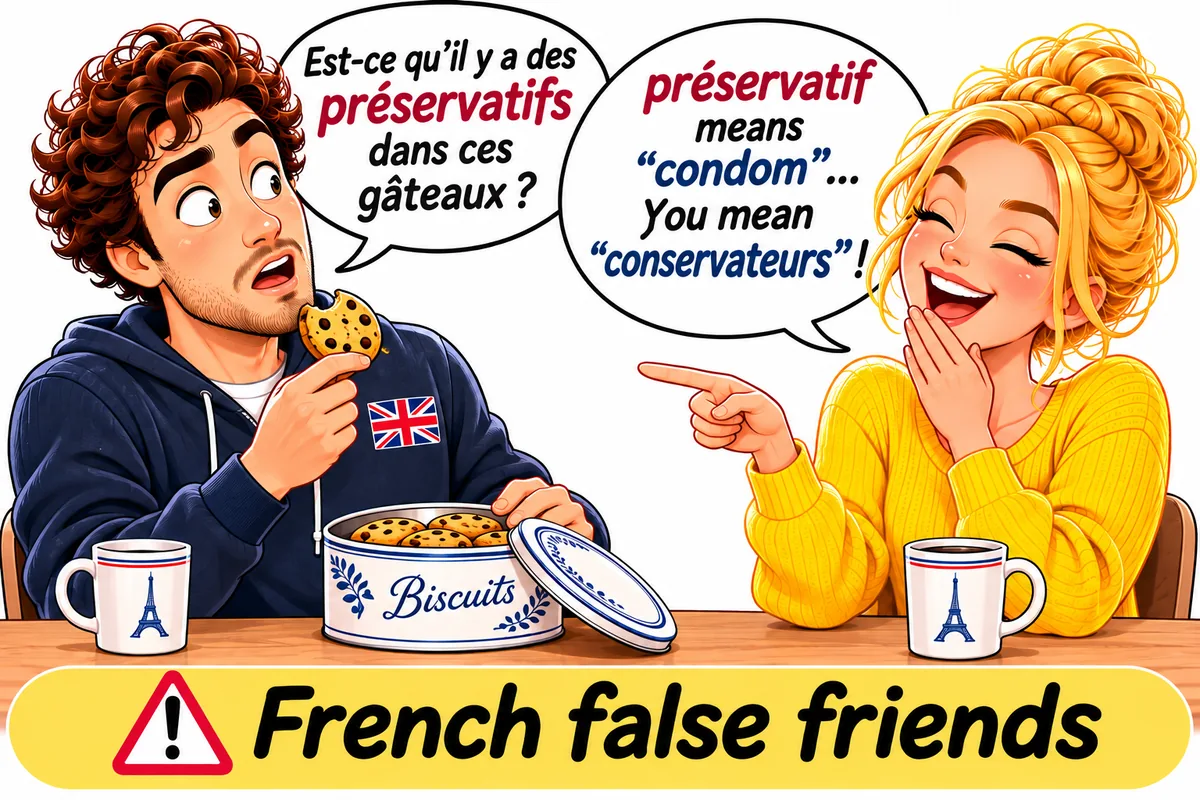
In English, “preservatives” are substances added to food to keep it fresh for longer. But in French, préservatifs means “condoms”! (The French word for food preservatives is conservateurs.)
So, instead of saying that Americans eat food containing preservatives all the time, my student had accidentally announced to the whole restaurant that Americans eat condoms!
Once I explained the difference in English, she burst out laughing too. We laughed so much that I am quite sure she won’t make the mistake again.
Préservatif is one of the classic French false friends, or faux amis: words that look familiar to English speakers but mean something completely different. Here are the ones you really need to know, grouped by situation, with what they actually mean and what to say instead.
What are false friends?
A false friend is a word that looks or sounds like a word in your own language but has a different meaning. They exist because French and English have borrowed from each other for centuries, and over time, words have evolved in different directions. Actuellement and actually come from the same Latin root, for example, but today they mean two very different things.
There are also partial false friends: words that share one meaning with English but have others too. They are the trickiest, because you will sometimes use them correctly and sometimes not.
French false friends at work
These ones can create real misunderstandings in meetings and emails:
| French word | What it really means | Don’t confuse with | Say instead |
|---|---|---|---|
| actuellement | currently, at the moment | actually | en fait |
| éventuellement | possibly, if necessary | eventually | finalement |
| assister à | to attend (a meeting, an event) | to assist | aider |
| un agenda | a diary, a planner | an agenda (of a meeting) | l’ordre du jour |
| réaliser | to carry out, to achieve (a project) | to realise (understand) | se rendre compte |
| contrôler | to check, to inspect | to control | maîtriser, diriger |
| demander | to ask | to demand | exiger |
| une formation | a training course | a formation (shape) | une forme |
| un stage | an internship, a training course | a stage (theatre) | une scène |
| un préservatif | a condom | preservatives | des conservateurs |
| rester | to stay | to rest | se reposer |
Meetings are where these words appear most often. If you work in French, my phrases to buy yourself time in a meeting and to sound more confident in meetings will help you choose the right words.
French false friends in everyday life
| French word | What it really means | Don’t confuse with | Say instead |
|---|---|---|---|
| une librairie | a bookshop | a library | une bibliothèque |
| rester | to stay | to rest | se reposer |
| attendre | to wait (for) | to attend | assister à |
| une location | a rental | a location | un endroit, un lieu |
| la monnaie | change, coins | money | l’argent |
| sensible | sensitive | sensible | raisonnable, sensé |
| sympathique | nice, friendly | sympathetic | compatissant |
| large | wide | large (big) | grand |
| une journée | a day | a journey | un voyage, un trajet |
| le raisin | grapes | raisins | les raisins secs |
| un crayon | a pencil | a crayon | un crayon de couleur |
| une lecture | reading, something to read | a lecture | un cours magistral, une conférence |
| le collège | secondary school (ages 11 to 15) | college (university) | l’université, la fac |
| une déception | a disappointment | a deception | une tromperie |
| blesser | to injure, to hurt | to bless | bénir |
| la chance | luck | chance (probability) | la probabilité, l’occasion |
False friends at the restaurant and in shops
Ordering food or buying clothes in France? These ones will save you from a few surprises:
| French word | What it really means | Don’t confuse with |
|---|---|---|
| une entrée | a starter | an entrée (main course, in American English) |
| le menu | a set menu at a fixed price | the menu (that’s la carte) |
| des chips | crisps (potato chips) | chips (French fries are des frites) |
| une veste | a jacket | a vest (un gilet or un débardeur) |
| un costume | a suit | a costume (un déguisement) |
| une robe | a dress | a robe (un peignoir) |
| des baskets | trainers, sneakers | baskets (des paniers) |
So if you ask for la carte, you get the full menu; if you choose le menu, you get the fixed-price meal of the day, often the best value at lunchtime.
The embarrassing ones
A few false friends can make French speakers smile… or blush. Better to know them in advance!
- Un préservatif is a condom, not a preservative. For food, say un conservateur: sans conservateurs means “no preservatives”.
- Je suis excité·e often sounds sexual in French. To say you are excited about something, use j’ai hâte (I can’t wait) or je suis impatient·e.
- Je suis plein·e does not mean “I’m full”. In familiar French, plein means drunk! After a big meal, say j’ai bien mangé or je n’ai plus faim.
- J’ai introduit ma collègue does not mean “I introduced my colleague” in the sense of introducing her to someone. In French, the verb introduire usually means “to insert” or “to put something inside something else.” So, when used with a person, it can sound rather awkward or even suggest something sexual! To introduce someone, use présenter: je vous présente ma collègue.
Partial false friends: the trickiest of all
Some words share a meaning with English but have another one too. Context is everything:
- Une application is an app, as in English, but also the act of applying something (a rule, a cream). A job application is une candidature.
- Un caractère is someone’s temperament (elle a du caractère, she has a strong personality). A character in a book or film is un personnage.
- Ignorer can mean to ignore, but also not to know: j’ignore la réponse means “I don’t know the answer”.
And don’t forget the true friends
False friends get all the attention, but they are a small minority. Most look-alike words really do mean the same thing, and you can use them with confidence. A useful pattern: many English words ending in -tion are identical in French (information, situation, communication), and many words ending in -ty become -té in French (university → université, quality → qualité).
Remember that even when the word is the same, the pronunciation is not! Giving each syllable the same weight makes a huge difference, as I explain in my French pronunciation tips for English speakers.
How to avoid false friends
- Learn them in context. Instead of memorising a list, write a short sentence with each word: Actuellement, je travaille à Paris.
- Group them by situation. Learn the work ones before your next meeting, the everyday ones before your next trip.
- Be curious when a word looks too easy. If a French word looks exactly like an English one but the sentence doesn’t quite make sense, check it.
- Practise speaking. False friends become automatic only when you use them in real conversations, and someone gently corrects you.
Learning these words early saves you a lot of confusion, and it is one of the small things that help you progress faster. If you are wondering how long the whole journey takes, read how long it takes to learn French.
Test yourself!
Translate these sentences into French, avoiding the false friends.
- I’m currently working on a new project.
- I attended a training course last week.
- She is very sensitive.
- Is there a bookshop near here?
- I can’t wait to visit Paris!
See the answers
- Actuellement, je travaille sur un nouveau projet.
- J’ai assisté à une formation la semaine dernière.
- Elle est très sensible.
- Est-ce qu’il y a une librairie près d’ici ?
- J’ai hâte de visiter Paris !
Want to use your French with confidence, without the traps? In French conversation classes online, you practise everyday French out loud, every week, in a small group of up to 6 people, with gentle corrections along the way.
Let’s start with a free 30-minute discovery call on Zoom, with no commitment.