

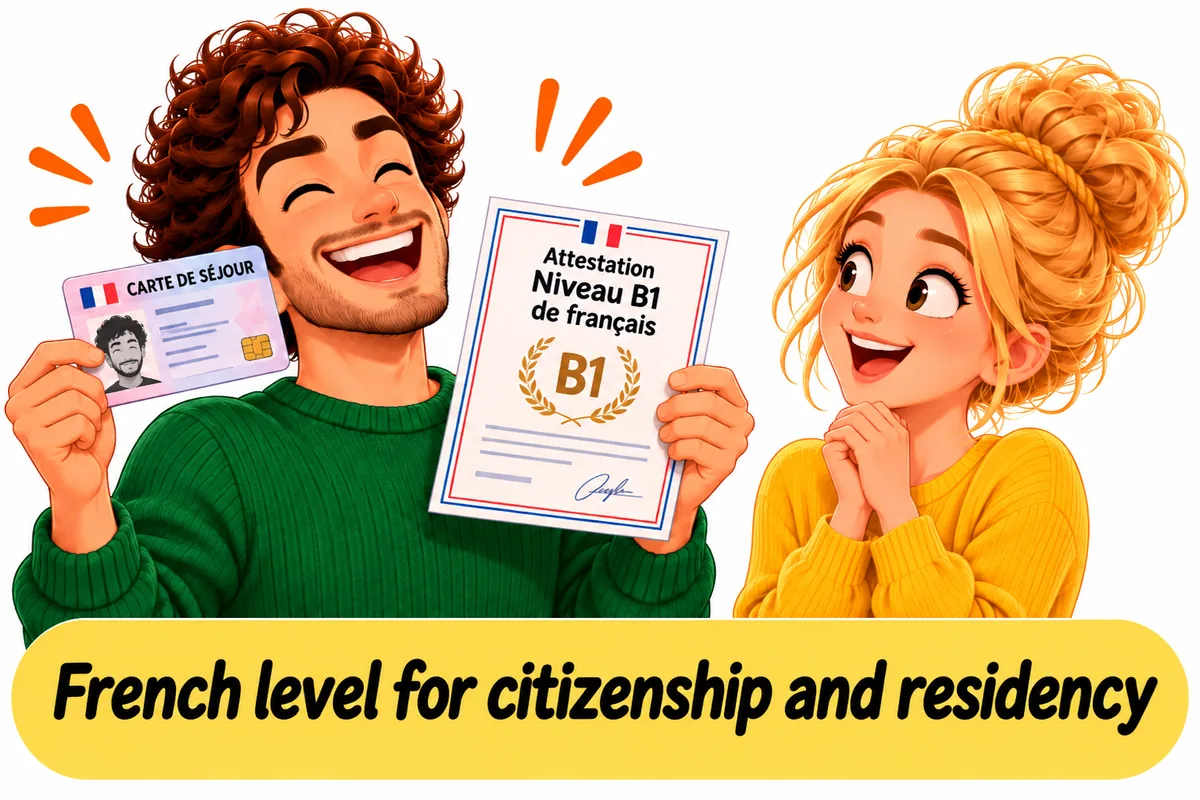
Since 1 January 2026, France has raised its language requirements for residence permits and citizenship. If you are planning to apply for a residence card or for French nationality, you now need a higher French level for citizenship and long-term residency than before.
Many of my students are expats living in France, and these new rules raise a lot of questions. In this guide, I explain which level you need for each application, how to prove it, what the new civic exam involves, and how to prepare calmly.
Information checked against the official service-public.gouv.fr pages in October 2026. Rules can change, so always check the conditions that apply to your own situation with your préfecture.
The French level required for each application
Here is a summary of the new requirements:
| Application | Level required (CEFR) | What has changed |
|---|---|---|
| First multi-year residence permit (carte de séjour pluriannuelle) | A2 | Required for first applications since 1 January 2026 |
| First 10-year resident card (carte de résident) | B1 | Previously A2 |
| French nationality by decree or by marriage (naturalisation) | B2, both spoken and written | Previously B1 |
For residence permits, the requirement applies to non-European nationals under 65 who are making a first application. Not every category of resident card is concerned, so check yours on the official service-public.gouv.fr page.
What do A2, B1 and B2 actually mean?
These levels come from the Common European Framework of Reference for Languages (CEFR), a European scale used to assess language skills from A1 (beginner) to C2 (advanced mastery), in speaking, listening, reading and writing.
- A2: you can manage in simple, familiar situations. You can introduce yourself, go shopping and talk about your daily life.
- B1: you are independent. You can describe an experience, give your opinion in simple terms and handle most everyday situations.
- B2: you are comfortable. You can argue a point, understand the main ideas of a debate or an article, and talk spontaneously with French speakers.
Moving from B1 to B2 is a real step, especially in writing: you need to structure your ideas and build an argument. As a rough guide, it usually takes between 150 and 250 hours of lessons to go from B1 to B2. It depends on what you already know, how regularly you study and how often you practise French outside your lessons.
What B2 looks like in real life
- You can follow a radio programme or a work meeting without asking people to slow down all the time.
- You can explain a problem at the préfecture, the bank or the doctor’s, and understand the answer.
- You can write a structured email or letter giving your point of view, with arguments and examples.
- You can disagree politely and defend your opinion in a conversation.
How to prove your French level
For the multi-year residence permit and the resident card
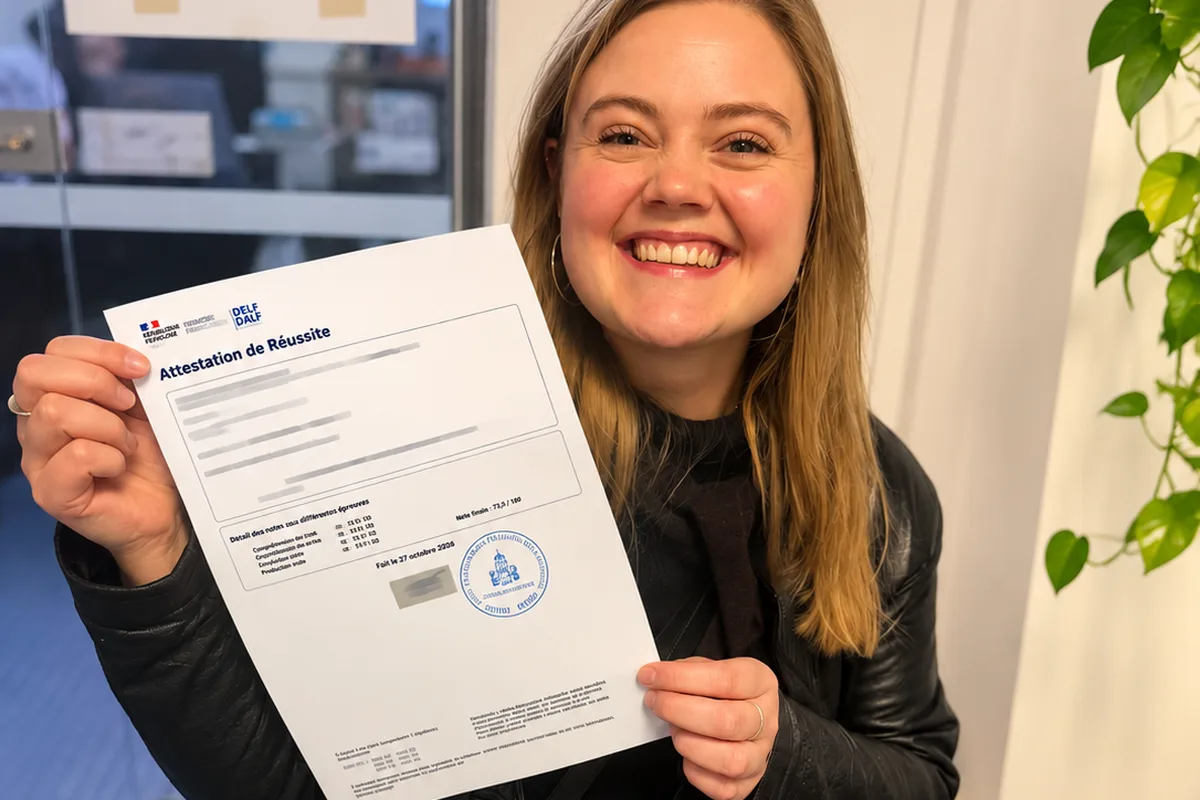
- A TCF or TEF certificate. The TCF is run by France Éducation international and the TEF by the Paris Chamber of Commerce (CCI Paris). All four skills (speaking, listening, reading and writing) must be tested on the same day, in person, in an exam centre. The certificate is valid for 2 years.
- A French language diploma at the required level: DELF, DALF, DELF Pro, DCL, DFP or DUEF.
- A French diploma at level 3 or above (such as the CAP, BEP or diplôme national du brevet), or a level 3 professional certification registered with the RNCP.
Be careful: diplomas obtained abroad are not accepted, even if they come from a French-speaking country.
For French nationality
- A TCF or TEF certificate at B2 level, issued less than 2 years before your application.
- A French diploma: the diplôme national du brevet, a state diploma at level 3 or above, a level 3 professional certification registered with the RNCP, or any diploma showing a level at least equal to B2.
Good to know: a DELF or DALF diploma never expires, unlike TCF and TEF certificates, which are valid for 2 years.
TCF, TEF or DELF: which one should you choose?
The three options are all accepted, but they work differently:
| TCF / TEF (versions for residence and nationality) | DELF / DALF | |
|---|---|---|
| What you get | A certificate showing your level | A diploma for one specific level |
| Validity | 2 years | No expiry date |
| Result | You get the level you reach on the day | You pass or fail the level you registered for |
| Best if… | You need a certificate quickly for one application | You want a lasting proof of your level |
The versions designed for administrative applications are called the TCF IRN and the TEF IRN (intégration, résidence et nationalité). If you are unsure, ask the exam centre before registering.
Exemptions
If your health or a disability makes the assessment impossible, an exemption may be granted with a medical certificate, and exam adjustments are also possible. For naturalisation by decree, refugees and stateless people aged over 70 who have lived in France for at least 15 years are exempt.
What about the civic exam?
The language level is not the only new requirement. Passing a civic exam is now required for the multi-year residence permit and the resident card, and it also applies to French nationality. According to the decree of 10 October 2025, the exam has 40 multiple-choice questions, and you need at least 32 correct answers to pass.
The exam is in French, so you need good reading comprehension to succeed. It checks your knowledge of the values and principles of the French Republic, the rights and duties of people living in France, and how French institutions and society work.
My advice to prepare
- Assess your level skill by skill. It is very common to feel comfortable speaking but less confident in writing, or the other way round.
- Choose your exam (TCF, TEF or DELF/DALF) according to your application and your deadline. When you register, tell the exam centre that the test is for a residence or nationality application: there are dedicated versions.
- Plan ahead. Check exam dates at your centre early and leave a comfortable margin before submitting your application.
- Practise the exam format. Knowing exactly how the exam works is half the battle, and there are many practice books to help you.
- If you are aiming for B2, work on writing and argumentation. That is often where the difference is made.
At B2, you are also expected to express and defend your opinion out loud. If you use French at work, my phrases for sounding more confident in meetings (B2 level) are excellent practice for the speaking part.
Frequently asked questions
Does an old DELF diploma still count?
Yes. DELF and DALF diplomas have no expiry date. Only TCF and TEF certificates are limited to 2 years.
Can I take the TCF or the TEF online?
No. For residence and nationality applications, all four skills must be tested on the same day, in person, in an approved exam centre.
I am over 65. Does the language requirement apply to me?
For residence permits, the requirement concerns non-European nationals under 65 making a first application. For nationality, check the exemptions on the official service-public.gouv.fr page.
Is my B1 level enough for French citizenship?
Not anymore. Since 1 January 2026, applicants for French nationality must prove a B2 level, both spoken and written. B1 is now the level required for the first resident card.
Preparing an application and aiming for B1 or B2? In private French lessons online, we build a programme around your deadline and the format of your exam. In 16 years of teaching, I am proud to say that all of my students who prepared an exam with me passed it, from A2 to C2.
Let’s start with a free 30-minute discovery call on Zoom to assess your level together.
Official sources
- Carte de résident et carte de séjour pluriannuelle : comment justifier de votre connaissance du français ? (service-public.gouv.fr)
- Nationalité française : comment justifier de son niveau en français ? (service-public.gouv.fr)